



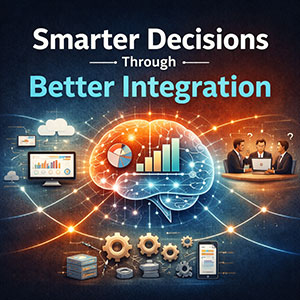
 In today’s business environment, complexity isn’t optional. It’s inevitable.
Organizations operate across multiple platforms, manage growing volumes of data, and coordinate teams that are increasingly distributed. While technology has enabled unprecedented access to information, it has also introduced a new challenge: how to turn that information into meaningful, timely decisions.
The question is no longer “Do we have enough data?” It’s “Are we using it effectively?”
The Paradox of More Tools
Over the past decade, companies have invested heavily in digital transformation. New platforms promise automation. Dashboards promise insight. Analytics promise predictive clarity.
Yet many organizations still experience:
Fragmented systems that don’t communicate well
Delayed reporting cycles
Manual workarounds between departments
Limited visibility across operations
Decision bottlenecks at leadership levels
More tools have not automatically created better outcomes. In many cases, they have increased operational noise.
Why Integration Matters More Than Ever
Modern performance depends less on individual systems and more on how well those systems work together.
When data flows seamlessly across platforms:
Teams gain shared visibility
Reporting becomes real-time instead of retrospective
Cross-functional collaboration improves
Leaders can shift from reactive to proactive planning
Integration reduces friction. Reduced friction accelerates execution.
From Data Collection to Decision Intelligence
Data alone does not drive performance. Context does.
Organizations that excel in today’s landscape focus on:
Data alignment: Ensuring metrics across departments tell a consistent story
Operational transparency: Making performance visible at every level
Automation with intention: Automating processes that create measurable impact
Scalable infrastructure: Designing systems that support growth rather than hinder it
When these elements are aligned, decision-making becomes less about interpretation and more about action.
The Role of Strategic Technology Planning
Technology decisions should not be isolated IT initiatives. They are business decisions with long-term strategic implications.
Forward-thinking organizations treat technology as:
A growth enabler
A collaboration engine
A visibility platform
A strategic differentiator
This mindset shift transforms digital investments from cost centers into performance accelerators.
Building Clarity in a Complex World
Complexity is not going away. Markets will continue to evolve. Customer expectations will continue to rise. Systems will continue to multiply.
But organizations that prioritize clarity through thoughtful integration, intentional automation, and aligned data strategies will consistently outperform those that rely on disconnected tools.
Smarter systems create smarter decisions.
Smarter decisions create sustainable growth.
Continuing the Conversation
At SmartPath Technologies, we are passionate about exploring how businesses can reduce digital friction and strengthen decision-making frameworks.
If this topic resonates with your organization, we invite you to:
Follow our blog for ongoing insights on technology strategy and operational excellence
Share this article with colleagues navigating similar challenges
The path forward is not about more technology. It is about better alignment.