



Most organizations focus heavily on growth metrics. Revenue targets. Customer acquisition. Market expansion.
But fewer take the time to examine something equally important: operational efficiency.
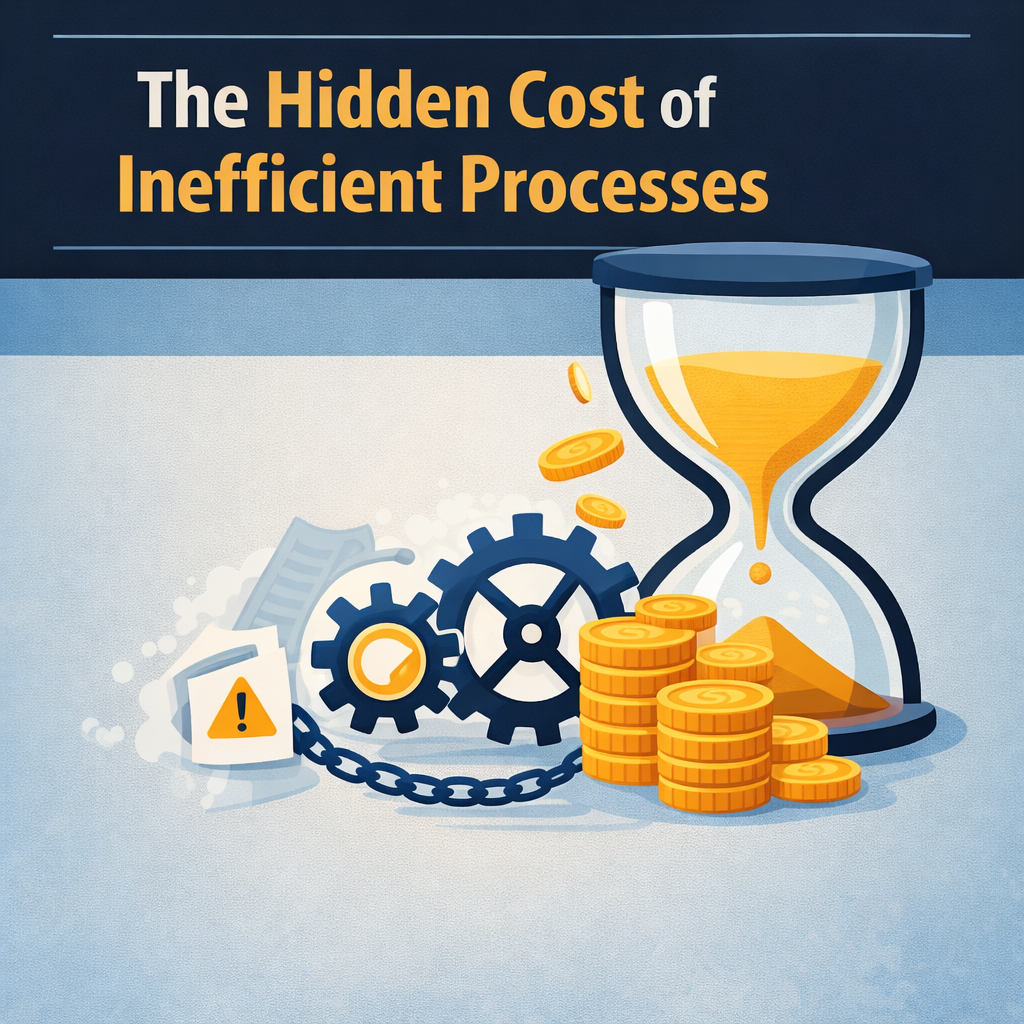
Inefficient processes rarely make headlines inside an organization. They develop gradually, hide within routine workflows, and often feel “normal.” Over time, however, they create measurable drag on performance, morale, and profitability.
The challenge is not that inefficiencies exist. The challenge is that many teams stop noticing them.
What Inefficiency Really Looks Like
Process inefficiency does not always appear as a major system failure. More often, it shows up in subtle ways:
- Repetitive manual data entry across multiple systems
- Teams maintaining separate spreadsheets to compensate for reporting gaps
- Frequent status meetings just to clarify information
- Approval processes that stall due to unclear ownership
- Employees spending more time gathering data than analyzing it
Individually, these issues seem minor. Collectively, they consume hours of productive time each week.
The Compounding Effect
Small inefficiencies multiply over time.
If one employee spends just 30 extra minutes per day navigating disconnected systems, that equals more than 120 hours per year. Multiply that across departments, and the hidden cost becomes substantial.
Beyond time, inefficiency impacts:
- Decision speed
- Data accuracy
- Employee engagement
- Customer responsiveness
- Strategic agility
Operational friction slows everything down.
Why Inefficiencies Persist
If inefficiencies are costly, why do they remain in place?
Several factors contribute:
- Legacy systems that no longer match current business needs
- Rapid growth without process standardization
- Technology added incrementally rather than strategically
- Lack of visibility across cross-functional workflows
- Resistance to revisiting established routines
Often, organizations adapt around inefficiencies rather than addressing them directly.
How to Start Identifying Gaps
Improvement begins with awareness. Leaders can start by asking practical questions:
- Where do teams rely on manual workarounds?
- Which reports require the most effort to compile?
- Where do delays most frequently occur?
- Are systems integrated or isolated?
- Do employees trust the data they use daily?
Patterns usually emerge quickly.
Another helpful step is mapping a single core workflow from beginning to end. Visualizing the full process often reveals redundancies, bottlenecks, and unnecessary handoffs.
The Role of Intentional Technology
Technology alone does not eliminate inefficiency. Intentional technology does.
When systems are aligned with business objectives and integrated thoughtfully, organizations gain:
- Clear data visibility
- Reduced duplication of effort
- Faster reporting cycles
- Improved cross-team collaboration
- Greater confidence in decision-making
Efficiency is not about doing more work. It is about removing what does not add value.
Building a Culture of Continuous Improvement
Operational excellence is not a one-time initiative. It is an ongoing discipline.
Organizations that regularly evaluate workflows, measure performance data, and invite employee feedback are better positioned to adapt as they grow.
Efficiency creates capacity. Capacity creates opportunity.
Continuing the Conversation
At SmartPath Technologies, we explore practical ways organizations can reduce operational friction and strengthen the systems that support growth.
If this topic resonates with your team, consider:
- Reviewing one core workflow this quarter
- Opening a cross-department conversation about process pain points
- Following our blog for additional insights on operational clarity and technology strategy
Sustainable growth begins with strong foundations. And strong foundations are built on efficient, intentional systems.